
Scope creep: how big a buffer should your quote include?
Scope creep rarely arrives as one big request. It arrives as a dozen small ones, each too small to mention, until a profitable project is a loss. A scope buffer is the allowance in your quote that pays for those small changes. The question is how big it should be.
Use your own history, not a rule of thumb
Any figure quoted as typical is somebody else’s average. Yours is in your past projects. For your last five, write down the hours you quoted and the hours you worked.
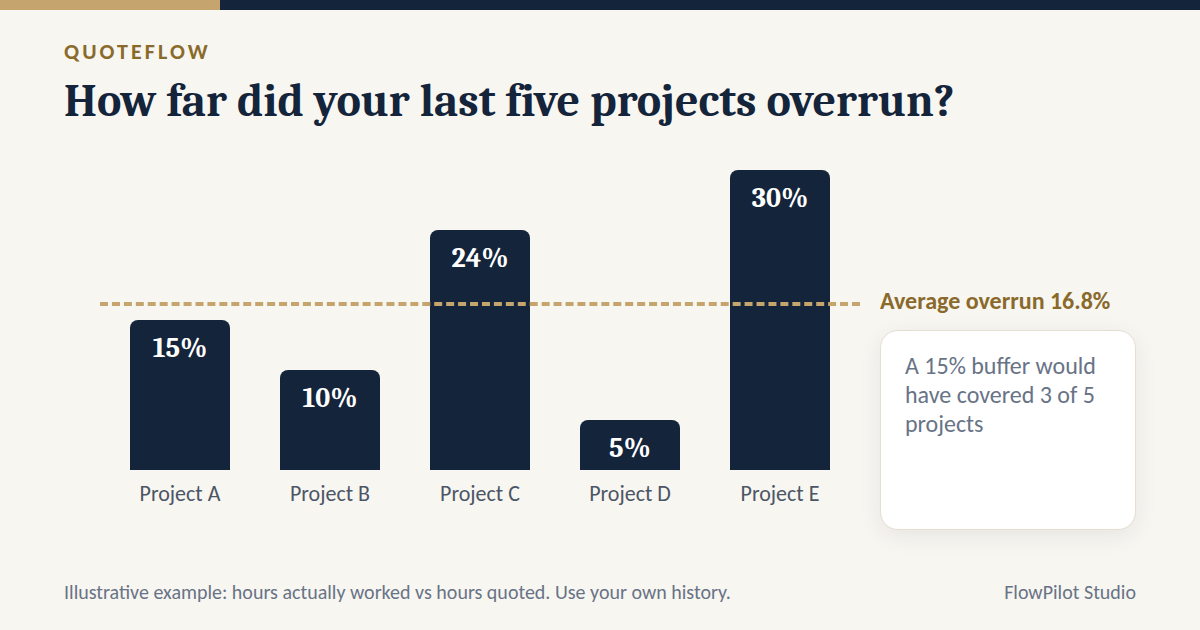
In this example the overruns were 15%, 10%, 24%, 5% and 30%, an average of 16.8%. A 15% buffer would have covered three of the five projects.
What a too-small buffer costs
On the 92-hour quote from our worked example, a 5% buffer against an expected 15% overrun leaves a gap of roughly 10% of the hours: 0.10 × 92 hours × S$92.86 is about S$854 of work you do for nothing. That is why the free QuoteFlow report flags a buffer under 10% and shows the estimated exposure.
Make changes billable
- Write the assumptions on the quote. State what the client supplies and by when.
- List exclusions. Anything not listed is out of scope.
- Name a change-order process. Say that work outside scope is quoted separately before it starts.
- Show the allowance. Put the scope allowance on its own line so the client sees what it covers.
Creative ways to use it
- Tune the buffer by client type. A new client with a vague brief needs more allowance than a repeat client.
- Review quarterly. After each project, add its overrun to your list and recalculate the average.
- Trade the buffer for a clear brief. Offer a lower buffer to clients who sign off scope in writing.
Pro (Business licence), coming soon: Use a change-order calculator that prices extra work against the original quote, and keep every quote saved for the next review. Join the Pro waitlist.
Try it with your own numbers
Set your own buffer in the free QuoteFlow calculator and watch the effective rate change. Your minimum rate comes from RateFlow.
The five-project figures are an illustrative example, not market statistics. Estimates only, not financial advice.